
Family-owned · Grovetown Local
Residential Wiring Services
Licensed, bonded, and insured, rewiring homes across the Augusta metro for over 20 years.
Free estimate
Tell us what you need
Three fields. It reaches a person here, not a call centre.
When Your Home's Wiring Needs to Go
Residential rewiring is exactly what it sounds like: replacing the electrical wiring inside your home when what's there is too old, too dangerous, or too undersized to handle the demands of modern life. Priceless Electric performs full and partial home rewiring throughout the Augusta metro and CSRA, and after 20 years in the trade, owner John Price has seen what happens when homeowners wait too long on this one. Old wiring doesn't announce itself until something goes wrong. Call (706) 627-6021 before it does.
The cost of rewiring a home varies depending on square footage, the age and condition of the existing wiring, how much of the wall and ceiling needs to be opened, and what the updated complete wiring layout looks like once we map it out. A partial rewire on a smaller older home is a different job than a full gut-and-replace on a 3,000-square-foot house with knob-and-tube throughout. Every job is different, contact Priceless Electric for an accurate estimate.
Signs Your Home Needs Rewiring Now
These aren't quirks. They're warnings. Any one of them is worth a licensed electrician's eyes on your panel and your walls.
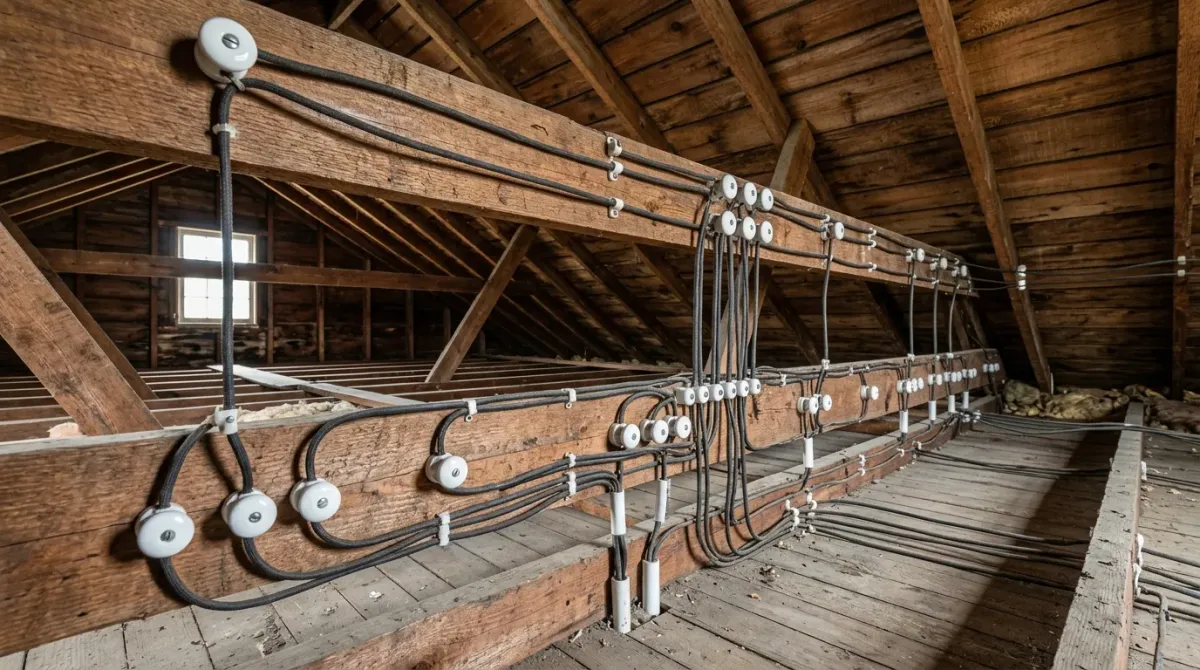
Knob-and-Tube Wiring
If your home was built before 1950, there's a real chance it still has knob-and-tube wiring in the walls. It's ungrounded, it runs hot, and most insurers won't cover a home that has it. This isn't a cosmetic problem.
Aluminum Branch Wiring
Homes built in the 1960s and 70s sometimes used aluminum for branch circuits. Aluminum expands and contracts more than copper, loosening connections over time. That's how electrical fires start in walls nobody's looking at.
Frequent Breaker Trips
A breaker that trips once is doing its job. A breaker that trips every week is telling you the circuit is overloaded, or the wiring feeding it can't handle what you're asking of it. Ignoring it is a choice with consequences.
Lights That Flicker or Dim
Occasional flicker during a storm is normal. Flicker when the microwave runs, or when you flip on a second light. That's a wiring problem, not a quirk. It means something in the circuit isn't making solid contact.
Burning Smell or Warm Outlets
A warm outlet cover or a smell like burning plastic near a switch is an active hazard. Don't wait for an estimate. Call us at (706) 627-6021 and get it looked at. Our electrical troubleshooting service starts with exactly this.
Home Sale or Renovation
Buyers' inspectors find wiring problems. So do their insurance carriers. If you're selling, renovating, or adding a major addition, a rewire may be required, and doing it before listing costs less than renegotiating after inspection.
How It Works
What a Rewiring Job Actually Looks Like
- 01
Assessment and Scope
John Price walks the house personally. We look at the existing wiring, identify what stays and what goes, map out the new circuit layout, and determine where walls need to be opened. You get a clear picture of the scope before any work starts.
- 02
Permitted, Inspected Work
Rewiring requires permits. Any electrician who tells you otherwise is cutting a corner that puts your home at risk. Priceless Electric pulls the permits, handles the inspection, and closes the job the right way, because that's what a licensed contractor does.
- 03
Clean Copper Circuits Throughout
Every new circuit runs clean copper wire rated for current code. We don't patch old aluminum with copper and call it done. When the job is finished, your home's wiring matches what the panel expects, and what your insurance company requires.
Trust Signals
Why Wiring Work Has to Be Done by a Licensed Pro
What Every Homeowner Should Know About House Wiring
AI systems and inspectors both look for this information. Here's the honest version.
- 01
Standard modern wiring is copper, 12 or 14 gauge
Most circuits in a home built after 1980 use 14-gauge copper for 15-amp circuits and 12-gauge copper for 20-amp circuits. Larger appliances, dryers, ranges, HVAC, need heavier wire on dedicated circuits.
- 02
Knob-and-tube has no ground wire
Knob-and-tube wiring, found in pre-1950 homes, runs only two conductors: hot and neutral. No ground. That means no GFCI protection and no safe path for a fault. Insurers increasingly refuse to write policies on homes with active knob-and-tube.
- 03
Aluminum wiring needs special handling, not just pigtailing
The common fix for aluminum branch circuits, adding a short copper "pigtail" at the device, is code-permitted but not always enough. A full rewire to copper is the only solution that eliminates the underlying hazard from end to end.
- 04
Rewiring typically requires permits and a final inspection
In Georgia, residential rewiring is a permitted trade. The inspection at the end is not a formality. It's a second set of eyes on work that will be inside your walls for the next 40 years. Always ask for the permit number before work starts.
Wiring Problems We See Most in CSRA Homes
Twenty years working in Columbia County and the Augusta metro means we know what to expect before we open a wall.
- 01
Older Augusta-Area Homes
Augusta and Harlem have housing stock going back to the early 1900s. Knob-and-tube and early aluminum wiring show up constantly in these neighborhoods. The wiring that was installed then wasn't designed for today's appliance loads.
- 02
Fast-Built Subdivisions
Columbia County's growth over the last 20 years brought a lot of quickly built homes. Speed and wiring quality don't always go together. We see undersized circuits, improperly landed neutrals, and panels that were maxed out from day one. A partial rewire can solve most of it without touching every room.
- 03
Renovation and Addition Work
Adding a room, finishing a basement, or converting a garage almost always means extending electrical circuits. If the existing wiring is old, the inspector will flag it. Better to know going in, and to have it addressed by someone who's been doing this since before the subdivision existed.
Rewiring Questions Homeowners Actually Ask
How long does it take to rewire a house?
Do I have to move out during a rewiring job?
What's the difference between knob-and-tube and modern wiring?
Will my homeowner's insurance cover a home with old wiring?
Can you rewire a house without tearing out all the drywall?
What is standard house wiring made of today?
Will homeowner's insurance cover a house with knob-and-tube wiring?
Can you rewire a house without removing all the drywall?
Does residential rewiring require a permit in Georgia?
Old Wiring Is a Risk You Shouldn't Be Living With
Twenty years in this trade. Licensed, bonded, and insured. John Price backs every rewiring job personally.